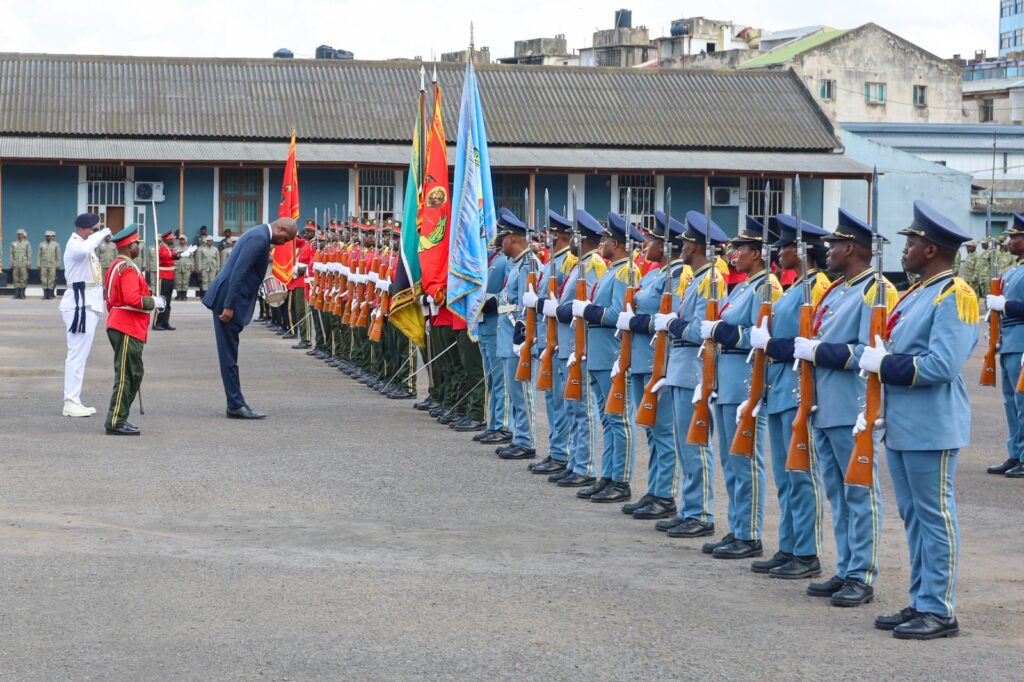
The President of the Republic of Mozambique and Commander-in-Chief of the Defence and Security Forces (FDS), Daniel Chapo, has called for the immediate disruption of terrorist logistical supply lines and greater operational dynamism in combating criminality through innovative strategies aimed at strengthening national security.
Addressing Rear Admiral Estevão Bernardo Nchokomala, newly appointed Commander of the Mozambique Navy, the President underscored the Navy’s central role in safeguarding national sovereignty, territorial integrity, and the protection of Mozambique’s extensive coastline. He highlighted responsibilities including maritime resource protection, security of navigation routes, and the fight against transnational threats such as terrorism, maritime piracy, human trafficking, drug trafficking, arms smuggling, and organized crime.
Within the framework of counterterrorism operations in Cabo Delgado, the Mozambique Navy is expected to assume a decisive role in coastal surveillance, maritime domain control, joint operations support, and, critically, the disruption of logistical supply routes sustaining terrorist elements.
The President stressed that effective maritime domain control is now a determining factor for the success of broader stabilization, pacification, and sustainable development strategies in Cabo Delgado and the country at large.
Blocking IS-M Maritime Logistics
For the newly appointed commandant, neutralizing the maritime logistical corridors used by Islamic State Mozambique requires a shift from reactive patrol patterns to intelligence-driven maritime interdiction.
IS-M has historically exploited Mozambique’s porous northern coastline, informal landing sites, mangrove estuaries, and fishing networks to move personnel, weapons, fuel, and supplies between coastal districts and offshore points. Small dhows and artisanal fishing vessels provide low-signature transport, complicating detection through conventional naval patrols.
To effectively block these routes, the Navy must integrate layered maritime domain awareness: coastal radar coverage, automatic identification systems (AIS) enforcement, drone-based ISR, and human intelligence penetration of coastal communities. Joint littoral operations with marine units and rapid-reaction forces are essential to interdict landing points rather than merely patrol open waters, which as long proven impossible.
Additionally, disrupting financial flows tied to maritime smuggling, fuel diversion, illicit timber, and narcotics will weaken IS-M’s logistical resilience. Cooperation with regional partners in the SADC, SADC SO such Regional Early Warning Centre and Regional Counter Terrorism Centre is equally critical, given cross-border movement through Tanzanian corridor and Indian Ocean corridors.
Failure to secure these maritime arteries risks allowing IS-M to retain operational depth, resupply capacity, and tactical mobility. Conversely, sustained maritime interdiction would significantly constrain insurgent endurance and recalibrate the operational balance in Cabo Delgado.