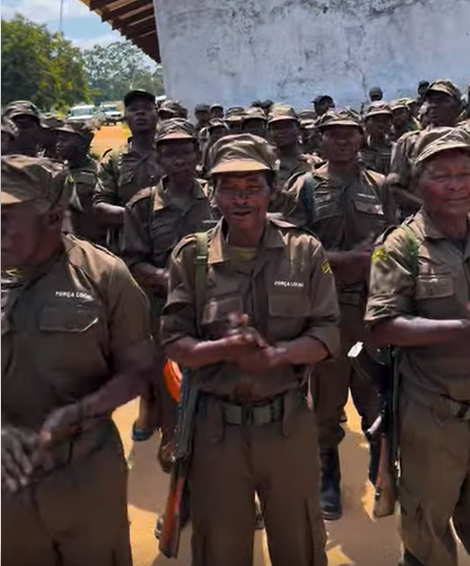
On 21 February, the spokesperson of the Local Defence Force deployed in counter-terrorism operations in Cabo Delgado, Gabriel Cassimuca, stated in the district of Mueda that the force is facing significant constraints in expanding its presence across the province due to shortages of financial resources, material means, and food supplies.
The remarks were made during a food donation event promoted by the Secretary-General of FRELIMO, Chakil Aboobacar. On that occasion, Cassimuca reiterated that the Local Force intends to extend its operational footprint to southern districts such as Balama, Namuno, and Mecúfi areas considered strategically sensitive in light of the risk of insurgent infiltration and dispersion.
Despite these limitations, the Local Defence Force has maintained operational coordination with the Mozambican Defence and Security Forces (FDS), participating in joint patrols, stabilization efforts, and territorial control operations, particularly in zones previously affected by the Islamic State de Mozambique.
Beyond food shortages, the force has also raised concerns regarding the lack of adequate weaponry, communications equipment, transport assets, and irregularities in the disbursement of subsidies to its members many of whom are veterans of the liberation struggle, their descendants, and local volunteers.
In Mueda, a curfew imposed from 20:00 has been justified as a preventive security measure and is viewed as having contributed to maintaining stability in a town that has not experienced direct terrorist attacks since the onset of the insurgency.
ANALYSIS
The Local Defence Force has assumed responsibilities traditionally attributed to military and police structures, including access control, searches, preliminary detentions, and support to both offensive and defensive operations in coordination with the Mozambican Armed Defence Forces (FADM) and Rwandan contingents.
The visit of the President of the Republic, Daniel Chapo, to Mueda on 27 February 2025 reinforced political and institutional recognition of the Local Force, highlighting its legal framework and role in community-based territorial defence.
However, its long-term consolidation as a complementary security actor depends on deeper institutionalization, clearer mandates, operational discipline, and sustainable logistical support. The politicization of its activities could undermine internal cohesion and weaken strategic coordination with the FADM. In the context of a mobile and asymmetric insurgency, the effectiveness of the Local Defence Force remains directly linked to its structured integration within the national security architecture.