The United States government has signaled its intent to fund a major rare earths initiative at Monte Muambe, an inactive volcano in Mozambique’s central Tete province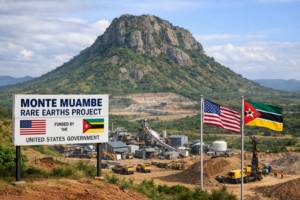 , marking the third significant US investment in the country’s natural resources sector since 2024. This move underscores Washington’s push to secure alternative supplies of critical minerals amid global efforts to diversify away from China-dominated supply chains.
In a recent market update from Altona Rare Earths PLC, a London-listed company specializing in critical raw materials exploration in Africa, the firm announced that the US Trade and Development Agency (USTDA) has confirmed its support for the Monte Muambe project. While specific funding amounts remain undisclosed, the backing aims to outline the technical and financial roadmap for development, focusing on rare earth elements essential for high-strength permanent magnets, defense technologies, and clean energy applications such as electric vehicles and wind turbines.
USTDA Deputy Director and Chief Operating Officer Thomas Hardy affirmed this commitment during a high-level meeting on US support for critical mining projects in sub-Saharan Africa, held in Cape Town, South Africa, on February 8, 2026. The support is contingent on finalizing a formal grant agreement, which is currently in preparation.
Altona, which holds a 51% stake in the project (set to increase to 70% upon completing a prefeasibility study), estimates the development cost at approximately $276.3 million. The mine is projected to produce around 15,000 tonnes of mixed rare earth carbonate annually over an 18-year lifespan, with ongoing reviews potentially refining these figures. The company anticipates results from its latest drilling campaign for fluorite and gallium soon, which could further validate the project’s viability as a source of these strategic materials.
Gallium, a rare metal used in semiconductors, radars, and LEDs, was discovered in high concentrations (up to 232 grams per tonne) at Monte Muambe in April 2025. With prices hovering around $250 per kilogram amid US-China trade tensions, this adds to the site’s appeal. Fluorite, another key component, enriches the carbonatite deposits within the 780-meter-high volcano’s six-kilometer-wide caldera, which features a 200-meter-deep crater.
This investment follows two prior US commitments: In 2024, the US International Development Finance Corporation (DFC) approved $150 million for Syrah Resources’ Balama graphite mine in northern Mozambique, supplying materials for electric vehicle batteries. In 2025, the US Export-Import Bank (EXIM) greenlit $4.7 billion in financing for TotalEnergies’ liquefied natural gas (LNG) megaproject in Cabo Delgado.
Altona’s CEO, Cedric Simonet, described the US endorsement as “a powerful external validation of the strategic quality and economic potential” of Monte Muambe. He emphasized its role in fostering resilient global supply chains for rare earths and fluorite, aligning with broader US initiatives like the 2026 Critical Minerals Ministerial, where the US announced over $30 billion in commitments to secure strategic minerals worldwide.
As global demand for rare earths surges driven by the energy transition and defense needs projects like Monte Muambe position Mozambique as a key player in Africa’s critical minerals boom, potentially attracting further international partnerships.
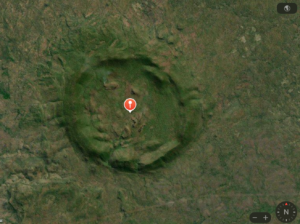
Mount satellite image
Analysis:
Impacts on Mozambique’s Security Environment
Mozambique’s security landscape in 2026 remains complex, marked by lingering insurgent threats in the northern Cabo Delgado province, post-election instability from 2024-2025, and broader challenges like kidnappings, corruption, and climate-induced vulnerabilities. The US-backed Monte Muambe rare earths project, located in the relatively stable central Tete province, could positively influence national security dynamics through economic stabilization, job creation, and enhanced international cooperation, though it also carries risks if not managed carefully.
Positive Impacts and Improvements
- Economic Growth and Stability as a Security Buffer:
Foreign direct investment (FDI) in mining and energy sectors is projected to reach a record $5.88 billion in 2026, a 22.6% increase, largely driven by LNG and critical minerals projects like Monte Muambe. This influx could generate thousands of jobs, boost local infrastructure (e.g., roads, power, and water systems), and increase government revenues, reducing poverty-driven unrest. Tete’s central location, away from Cabo Delgado’s Islamist insurgency, allows for safer operations, potentially serving as a model for secure resource development.
- Enhanced US Security Cooperation:
US investments often come with tied security support, as evidenced by DFC and EXIM’s involvement in prior projects. The Monte Muambe backing aligns with US counterterrorism priorities in Africa, potentially leading to increased training, intelligence sharing, or funding for Mozambican forces under frameworks like the Global Fragility Act. This could help contain the Islamic State-linked insurgency in the north, which has displaced over a million people and disrupted $20 billion in LNG investments since 2017. Improved security in resource-rich areas would protect US-backed assets and encourage more FDI, creating a virtuous cycle.
- Geopolitical Diversification and Reduced External Vulnerabilities:
By partnering with the US to develop rare earths, Mozambique reduces reliance on Chinese-dominated markets, which control over 80% of global supply. This strategic pivot could attract allied investments from Europe and Japan, enhancing diplomatic leverage and security alliances. Regional stability efforts, including Rwandan troop deployments in Cabo Delgado, might gain momentum if economic stakes rise, indirectly benefiting Tete through national resource revenue sharing.
- Local Community Benefits and Conflict Prevention:
Projects like Monte Muambe emphasize community development, potentially funding education, health, and anti-poverty programs in Tete, addressing root causes of insecurity like inequality and youth unemployment. Successful implementation could build public trust in government and foreign investors, reducing risks of protests or sabotage seen in post-2024 election unrest.
Potential Risks and Challenges
- Resource Curse and Localized Tensions:
Rapid resource development can exacerbate corruption, environmental degradation, and inequality, fueling grievances if benefits aren’t equitably distributed. In Tete, mining has historically led to land disputes and pollution; similar issues at Monte Muambe could spark local conflicts, potentially drawing insurgent groups southward.
- Spillover from Northern Insecurity:
While Tete is stable, Cabo Delgado’s violence threatens supply chains and investor confidence nationwide. If insurgents target critical infrastructure, Monte Muambe’s viability could suffer, delaying economic gains and worsening fiscal pressures.
- Geopolitical Rivalries:
US involvement might intensify competition with China or Russia, leading to proxy tensions or cyberattacks on projects. Post-election dialogues in 2025 aim to stabilize politics, but without inclusive reforms, instability could deter FDI.
Overall, the Monte Muambe project is likely to be net-positive for Mozambique’s security by driving economic resilience and international partnerships, provided the government prioritizes transparent governance, community engagement, and robust counterinsurgency measures. Projections suggest FDI-led growth could stabilize reserves and reduce debt burdens by 2026-2027, indirectly bolstering national security. However, without addressing underlying issues like corruption and regional disparities, it risks amplifying existing vulnerabilities.
========= =========