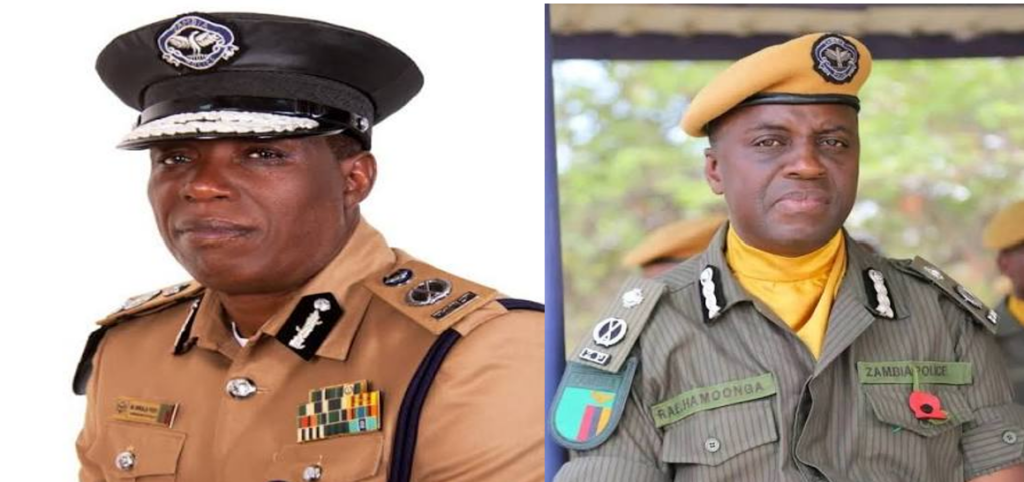
Provincial police commanders changed in two provinces within 72 hours, 14 days before polling. In Copperbelt, Commissioner Mwala Yuyi was transferred to Police Headquarters and replaced by Rae Hamoonga. Deputy Commanding Officer Geddy Divayi was separately transferred to Police Headquarters. No replacement or acting deputy has been publicly named. Two days after Yuyitos transfer, he was charged with theft by public servant involving US$448,596 alongside five others.
The reshuffle
| COMMAND | OFFICER LEAVING | SUCCESSOR / STATUS | WHAT THIS MEANS |
| Copperbelt: Commanding Officer | Mwala Yuyi moved to Police Headquarters, Lusaka (29 Jul) | Rae Hamoonga appointed Commanding Officer | The reshuffle will be judged politically as operationally. Opposition actors are likely to portray it alongside the Kamba case, as evidence of pressure on political competitors. Government actors may present it as routine accountability and command renewal. |
| Copperbelt: Deputy Commanding Officer | Geddy Divayi to Police Headquarters, Lusaka (30 Jul) | No successor or acting deputy publicly announced | Immediate security risk is that any unequal policing of rallies, roadshows, arrests, or public gatherings will be seen through these competing narratives, increasing grievances and the likelihood of localized protest. |
| Western: Commanding Officer | Rae Hamoonga moved to Copperbelt Province | Mubita Nawa appointed Commanding Officer | |
| Lusaka: earlier change | Roy Kashimba, Commissioner (Jan 2026) | Ronald Zaambo, previously deputy |
Former Home Affairs Minister Stephen Kampyongo publicly called the reshuffles “questionable” on 30 July, saying officers being promoted lack the competence to discharge the function. No police or government response on record at time of issue.
The Copperbelt commander’s record
| Officer | Relevant Record |
Security Significance |
| Mwala Yuyi | On 14 June, directed opposition campaign figures to leave the Copperbelt due to the campaign or presidential visit. During 23-24 July operations, NRPUP linked suspects in promoting public were charged and sent to court, while suspected UPND supporters were reportedly released after fines. Mwala was later transferred and charged with theft by public servants; the charge remains a legal allegation, not a finding of guilt. | The record creates a perception of uneven enforcement and places previous Copperbelt policing decisions under heightened scrutiny. |
| Geddy Divayi | Deputy Commanding Officer until transfer to Police Headquarters on 30 July. No public record currently links him personally to a specific election-related policing decision or misconduct allegation. | His removal leaves an information and command continuity gap. |
| Rae Hamoonga | Appointed Copperbelt Commanding Officer. No public record currently links him personally to a specific election related policing decision or misconduct allegation | His first decisions on rallies, arrests, and party access will be closely watched as indicators of enforcement consistency. |
| Mubita Nawa | Newly appointed Western Province Commanding Officer. No public record currently links him personally to a specific election related policing decision or misconduct allegation | Early engagement should assess whether command transition affects local readiness, political-party access, or management of sensitive public gatherings. |
Why it matters
- Command continuity has been disrupted in critical point in the Copperbelt, which carries the country’s heaviest recent election security caseload, 27 arrests on 26 July, 13 suspects charged on 23 July, and 01 bladed weapon attack resulting in 07 confirmed and 15 (unconfirmed) vehicles damage cases in Kitwe.
- The removal of both the Commanding Officer and Deputy therefore occurs mid caseload, creating short-term risks, intelligence flow, and consistent operational decisions. The 23 July disparity, in which NRPUP linked suspects were charged while suspected UPND supporters reportedly paid fines and were released, will now attract increased scrutiny because it occurred under Yuyi’s
- The timing of these events may be perceived as election-related, but available information does not establish political direction or ruling party intent.
- New commanders will be judged on predictable, proportionate, even-handed policing while inconsistency could heighten grievances and localized disorder during the campaign.
Together with the Kennedy Kamba detention, the reshuffle creates two rules of law narratives involving the police service in the final fortnight. Public commentary increasingly frames both developments as a ruling party strategy to constrain opposition activity. This perception does not establish coordination or intent, but it may intensify scrutiny and mobilized grievance locally.
What could follow – next 7 days
Election and political implications
The reshuffle creates immediate election security implications. First, the removal of the Copperbelt command during active cases may delay decisions, weaken liaison, and disrupt local intelligence flow. Second, Hamoonga’s first policing decisions will be treated as a test of whether enforcement has become more consistent and politically neutral. Third, parties are already likely to use the timing, alongside the Kamba case, to reinforce competing narratives of state control or institutional accountability. These effects do not prove ruling-party direction but test equal treatment.
|
SEVERITY |
CONSEQUENCE |
| HIGH | Enforcement decisions made under Yuyi’s command, especially the 13 unlawful procession cases, will face heightened political and legal scrutiny. The transfer and subsequent charge do not invalidate those cases but may strengthen opposition claims of uneven enforcement. |
| HIGH | During the meeting with Zambia Police, Police operational contacts for each province, including Copperbelt’s command, acting or substantive deputy, operations focal point will highly be required. Rae Hamoonga is the confirmed Commanding Officer, but Geddy Divayi’s replacement remains unconfirmed, creating a potential coordination gap. |
| MEDIUM | A new command may adjust enforcement practice rapidly to establish authority or demonstrate neutrality. Sudden changes in decisions on rallies, arrests, public gatherings, or party movements could be interpreted as political and raise local tensions. |
| MEDIUM | Further senior command changes, particularly in Southern, Northern, or Lusaka provinces, would increase perceptions of election-period security repositioning. The key indicator is whether operational changes are accompanied by consistent and even-handed policing. |
ASSESSMENT
The removal of the Copperbelt command, Yuyi’s reported charge of theft by public servants, the unresolved deputy succession, and Kamba’s detention are converging into a single narrative of politically selective law enforcement. Public commentary increasingly interprets these developments as government leverage over opposition activity. This perception is not evidence of central direction, but it will shape political behavior and increase scrutiny of every police decision.
The principal risk is loss of confidence in command neutrality, not immediate province wide violence. This may drive mobilization, contested arrests, and rapid escalation around rallies, courts, and electoral facilities.
- The arrival of 202 ballot pallets at Kenneth Kaunda International Airport under police escort, followed by 185 more, adds sensitivity. ECZ Chairperson Mwangala Zaloumis has rejected claims of extra printing in Tanzania and security force control of ballot materials. Delayed delivery and visible police involvement may reinforce existing distrust unless ballot handling remains transparent and consistently documented.
=========