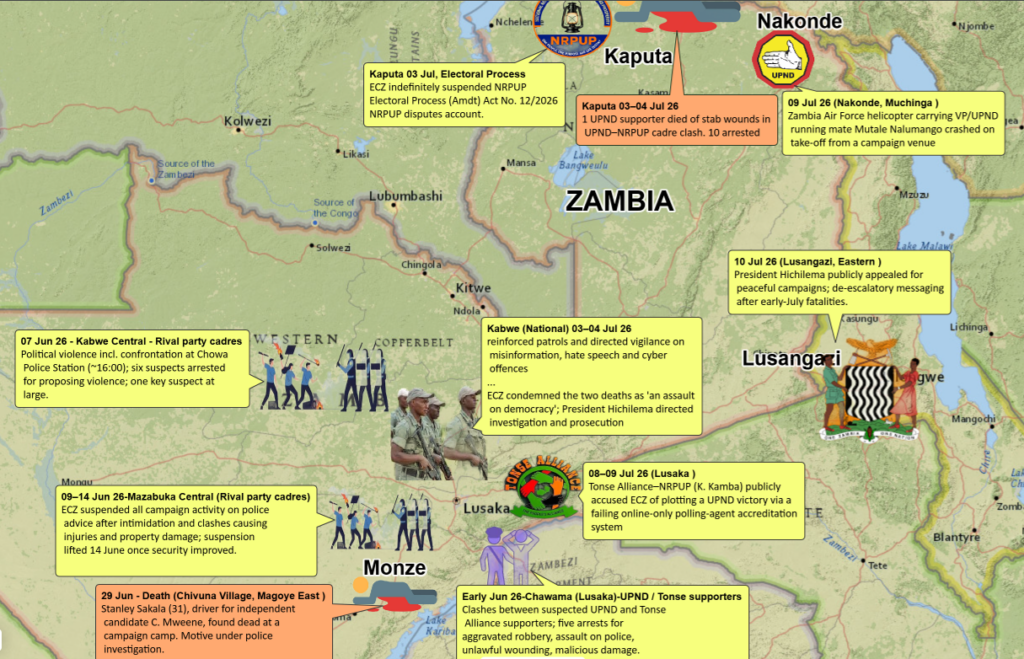
Zambia will hold elections on 13 August 2026.
With one month left, the campaign has already seen two confirmed deaths, the first court case over election-rule enforcement, and growing allegations that could affect whether people accept the final result.
This EWRAC weekly update covers 12 June to 13 July 2026. It follows the opening phase of the official campaign: the 50-day rotational campaign timetable began on 23 June, violence peaked in Northern and Southern Provinces in late June, and the period ended with a tense but calmer situation.
The main issue is the pattern behind the numbers. Two campaign-related deaths are confirmed, while the widely shared claim of 12 deaths is not verified. Street violence eased in the second week of July, but public trust in the ECZ weakened because of court cases, accreditation problems, and interference claims.
For governments, security agencies, diplomatic missions, observers, development partners, and investors, the key concern is whether Zambia’s election institutions can keep enough public trust to deliver a result that is seen as credible and accepted.
This report explains what happened, why it matters, and what to watch next. It uses verified open sources where available and gives confidence levels when information is incomplete.
- Executive Summary
One month before the 13 August election, the campaign has gone through two stages. Violence increased after the official campaign began on 23 June, including two confirmed deaths. After 8 July, street-level violence reduced.
As violence eased, disputes over the neutrality of the ECZ and other state institutions increased. Court cases, polling-agent accreditation problems, and interference allegations became the main issues in the final week of the reporting period.
- Situation Update
- 14 June: The ECZ ended the campaign suspension in Mazabuka Central after earlier clashes between political parties.
- 23 June: The official 50-day campaign period began. Campaign activities were organized under a rotational timetable.
- 29-30 June: Two campaign-related deaths were reported. One UPND supporter was killed during UPND–NRPUP clashes in Kaputa District, Northern Province, leading to ten arrests. Stanley Sakala (31), a driver to Confucius Mweene independent candidate, was also found dead at a campaign camp in Magoye East, Mazabuka District, leading to one arrest.
- 3 July: The ECZ suspended NRPUP campaigning in Kaputa It also rejected rigging claims and said ballots are being printed by Al Ghurair in Dubai under multiparty supervision.
- 5 July: FODEP called for the ECZ to apply campaign rules fairly to all parties.
- 7 July: NRPUP asked the court to review the Kaputa campaign suspension.
- 8–9 July: The Tonse Alliance and NRPUP said the ECZ’s online-only polling-agent accreditation system makes it harder for the opposition to register agents. Transparency International Zambia also criticized the possible mixing of state resources and campaign activities.
- 9 July: Vice-President Mutale Nalumango and seven others survived a Zambia Air Force helicopter accident at Nakonde. No injuries were reported.
- 10 July: President Hichilema called for peaceful campaigns.
- 11 July: Opposition figures accused the Local Government Service Commission of interference. Citizens First running mate Moses Mawere left the party and endorsed Tonse candidate Brian Mundubile.
- 13 July: Police stopped Citizens First leader Harry Kalaba’s campaign in Nakonde, saying a presidential visit was expected. Police also announced stronger election security measures based on a risk-classified security plan.
- Political Assessment
Campaign tensions are increasingly focused on whether the election process is fair. The opposition is mainly concerned that the President is exempt from the rotational campaign timetable, allowing him to hold about 27 rallies in one week while other candidates remain limited by province. The 13 July police blockade of Harry Kalaba’s campaign in Nakonde has strengthened this grievance. Growing support for Brian Mundubile may make the race more competitive, but it could also increase political tension in the final month. Moses Mawere’s defection also shows continued movement toward the Tonse NRPUP bloc.
The ECZ is facing growing public distrust. The main concerns are court challenges over campaign suspensions, problems with the online polling-agent accreditation system, uneven timing of penalties, and the still-pending decision on Magoye East. Together, these issues are creating grievances before election day. Moderate Confidence.
- Security Assessment
Violence has mostly been local and driven by party supporters. It has been concentrated in Kaputa, Mazabuka/Magoye East, Kabwe Central, and Chawama. EWRAC confirms two campaign-related deaths. Some open-source reports mention 12 deaths, but this figure is unverified and appears partly linked to reused 2021 election data. High Confidence on the confirmed fatality figure.
No campaign-related deaths were recorded between 8 and 13 July. Police have taken a firm approach and have acted against parties on both sides. More than 20 arrests have been made across fatal and non-fatal incidents. Moderate Confidence that violence is easing.
The Nakonde helicopter accident does not show signs of hostile action, but it highlights the transport risks linked to campaign travel. There is no credible terrorism threat affecting Zambia. Ebola activity in the DRC, especially near border areas, means Zambia should continue health monitoring in border provinces. Zambia has recorded no Ebola cases.
- Information Environment
Zambia is likely to face more AI-related misinformation and disinformation during the campaign. Claims about election rigging, the polling-agent accreditation dispute, and the Vice-President’s accident could spread online and be used to influence voters. These issues may also fuel divisive content, including conspiracy claims about sabotage or vote manipulation.
Police warnings about AI-generated content targeting officials may help reduce harmful misinformation. However, they may also raise concerns about limits on free expression under the Cyber Crimes Act No. 4 of 2025. Disinformation is likely to increase as polling day gets closer. Moderate Confidence.
- Strategic Analysis
During period, violence was localized and mainly involved rival party supporters. The two confirmed campaign-related deaths in early July marked a serious worsening compared with the peaceful nomination period in May. However, some public comments and opinion claims suggest that up to 12 people died. EWRAC has not been able to confirm this figure, and physical violence appeared to ease during the later part of the reporting period.
The main risk is now shifting from street clashes to mistrust in the electoral process. Disputes over ECZ decisions, the Kaputa suspension case, rigging claims, interference allegations, and polling-agent accreditation are increasing political tension. These issues could trigger protests or unrest, especially if parties reject court or ECZ decisions.
The 9 July helicopter accident involving Vice-President Mutale Nalumango appears to have been an accident, with no evidence of hostile action. All eight people on board survived without injury. Even so, the incident is important because it shows the risks linked to high-tempo campaign travel. It could also fuel misinformation and disinformation, including rumors, sabotage claims, and conspiracy narratives suggesting the incident was staged or intentional to gain sympathy and support.
- Early Warning Indicators
Key warning signs to monitor are any court decision on the NRPUP/Kaputa suspension, public reaction to that decision, whether the ECZ provides a physical backup for polling-agent accreditation, and the pending decision on Magoye East.
Other warning signs include new claims of rigging, sabotage narratives about the Vice-President’s helicopter accident, further limits on opposition campaigns, internet disruptions, heavier security deployments in hotspot areas, renewed party violence, and any confirmed Ebola case in Zambia.
- Risk Assessment
Political Stability: Moderate[1].
Election Violence: Moderate[2].
Civil Unrest: Moderate[3].
Disinformation: High[4].
Institutional Risk: High[5].
Border and Health Risk: Moderate[6].
Overall Election Risk: Moderate, but rising[7].
- Prognosis
Most likely over the next seven days, street-level violence will remain limited, but disputes over court cases, ECZ decisions, polling-agent accreditation, and campaign restrictions will intensify as the election approaches.
A worst case scenario would be a court ruling, ECZ decision, or police action seen as unfair. This could trigger localized protests or unrest, especially in areas already affected by political tension such as Northern and Southern Province.
- EWRAC Assessment
EWRAC assesses with Moderate Confidence that Zambia can still hold a peaceful election. However, the main risk is now the credibility of the process, not only physical violence.
The next two weeks will be important. Public acceptance of the 13 August election result will depend on how the ECZ, courts, police, and political parties handle campaign restrictions, accreditation access, pending sanctions, misinformation, and hotspot security.
[1] State institutions are still functioning, but public trust in the ECZ and other institutions is weakening
[2] Two campaign-related deaths are confirmed, but violence remains localized and appears to be easing
[3] Protests could occur if parties or supporters reject court rulings, ECZ decisions, or campaign restrictions
[4] rigging claims, accreditation disputes, and narratives about the helicopter accident could spread quickly and influence voter confidence
[5] distrust in the ECZ, especially over enforcement, accreditation, and pending sanctions, is the main weakness in the electoral process
[6] Ebola activity in the DRC and cross-border movement requires continued monitoring, although Zambia has recorded no Ebola cases
[7] The main concern is no longer only physical violence, but whether parties and voters trust the election process