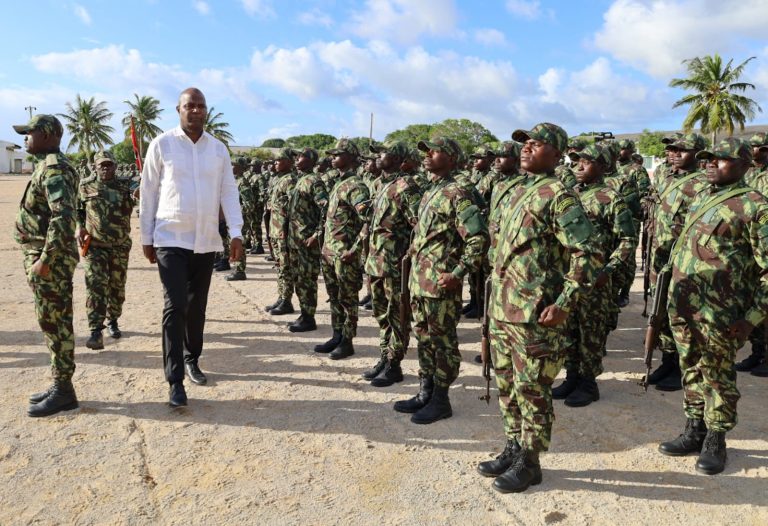
President Daniel Chapo stated that he expects to see and feel measurable progress in the fight against terrorism in Cabo Delgado during the official opening of the 2026 Military Operational Year.
The President commended the efforts of the Armed Forces and emphasized the need to reinforce protection of critical infrastructure, strategic natural resources, logistical and development corridors, the Mozambique Channel, as well as national air, land, and maritime domains. He framed these priorities as central pillars of military action in 2026, underscoring that national defense must directly safeguard the Mozambican people and the country’s long-term development trajectory.
“This year, we want to see and feel concrete progress in the fight against terrorism. Every soldier must recognize that they are an active participant in shaping the nation’s destiny, because the homeland is not an abstraction. It is our people. It is the future we are building together,” he stated.
President Chapo stressed that the Ministry of National Defense and the General Staff of the Armed Forces must treat counterterrorism as a strategic mission, ensuring that terrorism does not undermine Mozambique’s broader objective of achieving economic independence. At the same time, he cautioned against neglecting other dimensions of national security, calling for an integrated approach grounded in rigorous planning and disciplined execution.
He directed the Armed Forces of Mozambique (FADM) to define, stratify, and prioritize threats facing the state, placing counterterrorism at the top of the defense agenda while remaining attentive to other security challenges. As an example, he referenced Manica Province where the ceremony took place which has faced violent criminal activity by groups locally referred to as “homem catana,” (panga men) as well as increased influxes of individuals from various countries seeking gold exploitation opportunities.
ANALYSIS
“See and Feel” measurable progress in the fight against terrorism in Cabo Delgado. While the President’s intent reflects strategic urgency, the broader challenge extends beyond kinetic military success. Counterterrorism is not solely a task for the armed forces. Hard, purely kinetic approaches though necessary to neutralize immediate threats do not address structural drivers of radicalization. Mozambique has reached a point where progress depends significantly on political will to confront governance gaps, institutional weaknesses, and socioeconomic marginalization in Cabo Delgado.
The prolonged militarization of the conflict risks institutional fatigue and strategic dilution. When counterterrorism becomes normalized as a permanent condition, the threat gradually embeds into daily life, reducing national urgency and enabling adaptive insurgent tactics. In Cabo Delgado, many communities perceive the visible presence of armed force but limited parallel expansion of civilian state institutions focused on social equity, service delivery, and economic inclusion. This perception fosters alienation. Populations often feel trapped between insurgent coercion and military operations, weakening cooperation with security forces.
Large-scale economic projects in the Afungi basin and extractive sectors have intensified this perception. Communities frequently believe that military deployments prioritize protection of foreign investments rather than local livelihoods. Meanwhile, small-scale traders and transporters along corridors such as the N380 reportedly face taxation and looting by insurgent elements, with limited consistent protection. Where security presence is perceived as selective, grievances deepen.
Operationally, coordination gaps between the Mozambican Armed Forces (FADM), Rwandan forces, and Tanzanian elements in the Rovuma basin have complicated intelligence fusion and unified command structures. Fragmented external support and visibility competition among partners contributed to the withdrawal of the Southern African Development Community Mission in Mozambique, underscoring the difficulty of sustained regional alignment.
Reconstruction challenges persist in districts such as Macomia, affected by both insurgency and Cyclone Kenneth. Institutions including ADIN, INGD, INAS, and provincial state offices must demonstrate visible, equitable service delivery to rebuild trust. Ultimately, reversing Cabo Delgado’s trajectory requires a whole-of-state approach balancing calibrated military pressure with accountable governance, economic inclusion, and community-centered resilience. Without that balance, tactical gains risk strategic stagnation.