Period under review: January-February 2026
Coverage: Mocímboa da Praia, Macomia, Quissanga, offshore islands
Situation Overview
Islamic State-Mozambique (ISM) remains operationally resilient and tactically adaptive in northern Cabo Delgado, sustaining pressure on Mozambican security forces through coordinated ground and maritime actions, targeted raids, and exploitation of governance, intelligence, and humanitarian gaps. Recent clashes in Catupa forest, Muissune Island, and Macomia district demonstrate ISM’s continued capacity to contest state control along key transport corridors (N380) and coastal approaches, despite the joint Mozambican–Rwandan operations.
Simultaneously, flooding, cholera outbreaks, and population displacement are degrading state response capacity, compounding insecurity, and creating conditions that favor insurgent concealment, recruitment, and mobility.
Tactical Developments
ISM Offensive Operations in Catupa Forest
On 31 January, ISM launched simultaneous attacks on two Mozambique Defense Forces (FADM) positions at Namabo and Catupa, east of Quinto Congresso village and adjacent to the N380 national highway. The attack on Catupa continued into 1 February, with fighting resuming again on 7–8 February as FADM attempted to reassert control.
- IS media claimed nine FADM fatalities.
- Mozambican authorities confirmed five insurgents killed.
- ISM has been entrenched in Catupa forest since 2022, despite repeated ground and air operations by Mozambican and Rwandan forces.
These camps are isolated, difficult to resupply, and tactically exposed, connected only by a rough track constructed in late 2022. ISM’s objective is not territorial control, but rather:
- Seizure of military materiel
- Disruption of state operations
- Psychological pressure on isolated troops
- Erod population trust
- Financial control over mineral areas
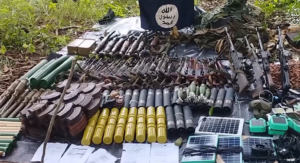
Captured weapons displayed by IS include mortars, RPGs, automatic rifles, and machine guns, confirming that arms capture has become a core operational enabler for ISM.
Control over Maritime and Coastal Activity in Mocímboa da Praia
30 January, a FADM naval patrol clashed with ISM terrorists around Muissune (Suna) Island, approximately 24 km offshore from Mocímboa da Praia port. At least three terrorists were killed, marking the second clash at the island in January. A week earlier, ISM fired on a naval patrol, missing its target.
In parallel:
- ISM terrorists entered Nanquidungaa village, south of Mocímboa da Praia, looted food supplies, and withdrew without violence.
- A Rwandan patrol responded, but no engagement occurred.
These incursions highlight ISM’s dual maritime land posture, allowing it to threaten ports, fisheries, and sea lines of communication while maintaining freedom of movement inland.
Economic and Civilian Impact
Macomia illustrates the convergence of insurgency, criminality, and alleged security force abuse:
- 26 January, the premises of trader Ali Maridade were looted and burned. The attack occurred in a supposedly secured central area, raising concerns about protection failures or collusion.
- 2 February, ISM terrorists stopped commercial vehicles near Manica village (Macomia–Mucojo road), extorting passengers and traders up to 30,000 meticais per person, exploiting the absence of escorts.
This environment:
- Increases the cost of doing business
- Undermines confidence in state protection
- Risks pushing communities toward accommodation with insurgents
Failed Intelligence and Coordination Breakdown
31 January, security forces detained approximately 30 young individuals in Tandanhangue (Quissanga district) on suspicion of insurgent links. The group later confirmed to be football players traveling from Pangane to Quirimba Island, they were transferred to Ibo Island, then released.
Consequences:
- Upon return, retaliatory violence erupted in Pangane, targeting residents of Quirimba origin.
- Homes were destroyed, deepening inter-communal tensions.
This incident underscores systemic intelligence failures:
- Poor community intelligence vetting
- Lack of coordination between local authorities, communities, and security forces
- Reactive profiling replacing targeted, evidence-based intelligence
Such actions directly fuel grievances, weaken trust, and risk creating new recruitment pathways for ISM.
The Fight for Catupa Forest
Catupa forest occupies a strategic wedge:
- West: N380 highway
- East: Indian Ocean
- North: Messalo River valley
After the insurgents were being displaced from Messalo in 2021, ISM repositioned into Catupa, forcing FADM to establish static positions in 2022. Since then:
- At least five major assaults on these bases have occurred.
- Rwandan air and ground interventions (2022, 2024, 2025) have been temporary and non-decisive.
The continued manning of isolated bases raises strategic questions:
- They do not exert effective area control
- They remain logistical liabilities
- They provide ISM with recurring opportunities for arms capture
LNG Restart Under Persistent Threat
The formal relaunch of the $20 billion Mozambique LNG project by TotalEnergies in Afungi, Palma district, with production targeted for 2029, marks a major economic milestone. However:
- Persistent insecurity along the N380 corridor
- ISM’s continued maritime presence
- Weak intelligence coordination inland
represent latent strategic risks to logistics, workforce movement, and investor confidence, particularly if insurgents seek to reassert relevance through high-impact attacks.
Natural Calamities and Security Consequences
Floods and Cholera
Mozambique is facing severe flooding, particularly affecting Cabo Delgado, Nampula, and Tete, with cascading effects:
- Population displacement, increasing civilian movement through insecure areas
- Degraded road access, limiting security force mobility and resupply
- Strained health services, amid a cholera outbreak nearing 5,000 suspected cases
In Cabo Delgado, misinformation surrounding cholera response led to the vandalism of a health center in Montepuez, highlighting:
- Fragile state–community trust
- High susceptibility to rumors and manipulation
Security perspective, floods:
-
- Reduce surveillance and patrol effectiveness
- Create humanitarian cover for insurgent movement
- Divert state attention from counter-insurgency to emergency response
Analysis
The current security environment in Cabo Delgado reflects not an insurgent resurgence, but a failure to consolidate military gains. ISM’s strength lies less in numbers and more in its ability to:
- Exploit intelligence gaps
- Leverage isolated military deployments
- Manipulate civilian grievances
- Operate across land–sea–humanitarian seams
The lack of effective intelligence coordination between communities, local authorities, FADM, Rwandan forces, and humanitarian actors such as SADC Emergency Response Team (ERT) remains the most critical vulnerability. Floods and public health crises further degrade situational awareness, fragment command-and-control, and expand ungoverned spaces.
Unless intelligence-led operations replace reactive deployments, and unless civilian trust is restored through disciplined, coordinated security conduct, ISM is likely to sustain low-cost, high-impact operations, particularly along the N380, Catupa forest, and coastal/island zones, undermining stabilization efforts and placing long-term investments at risk.
=====